If you are planning to start a private practice in the UK as a solo private healthcare practitioner, this guide is for you. It is written for people who work alone or nearly alone: therapists, physiotherapists, psychologists, counsellors, nutritionists, osteopaths, chiropractors, and similar roles. It is not aimed at large clinics or multi-practitioner businesses.
Starting a private practice gives you control over your hours, fees, and how you work. It also brings obligations that training often skims over: HMRC, ICO, insurance, consent and intake forms, invoicing, and online booking. The sections below follow a practical order so you can set things up before your first paying client and keep private practice admin from taking over your evenings.
This article is general guidance only. For legal, tax, or regulatory certainty, check current government and professional body rules or speak to a qualified adviser. Requirements differ by profession and by how you structure your work.
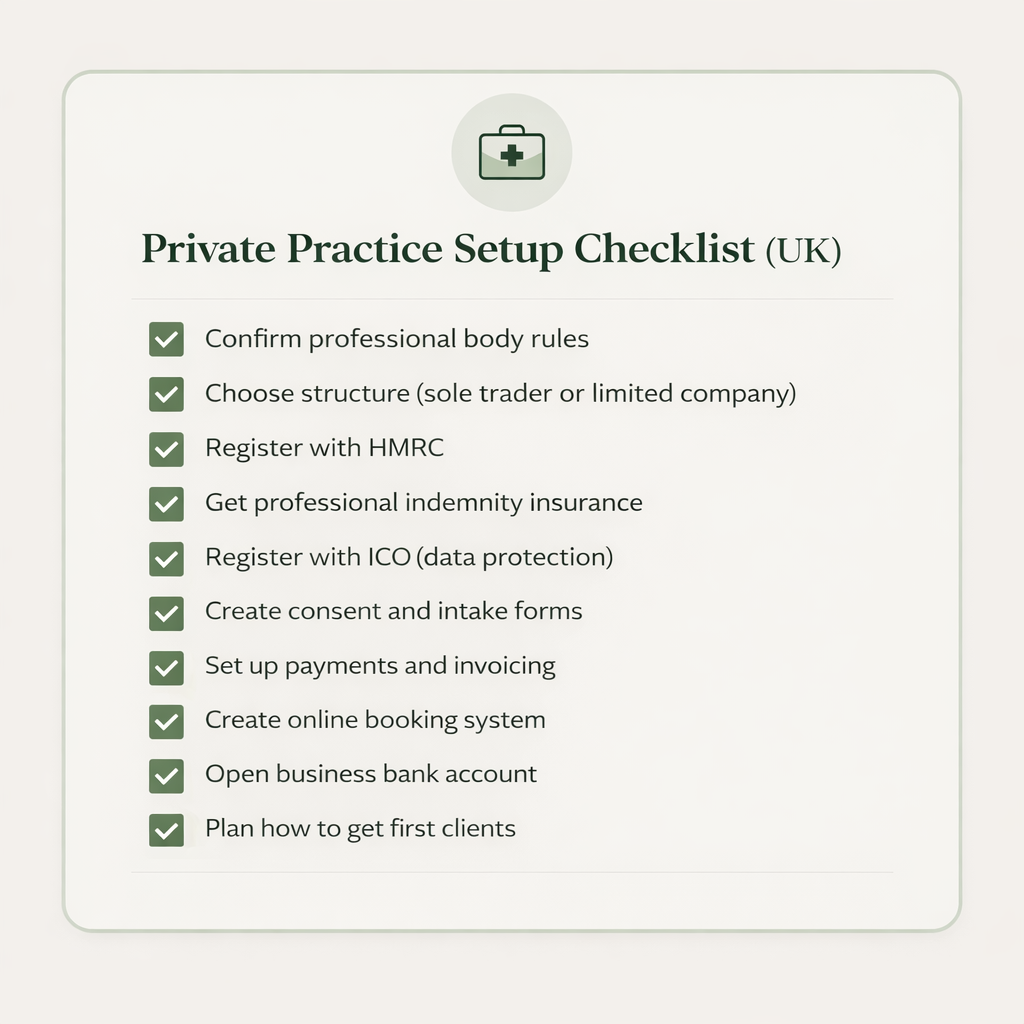
Private practice checklist UK: what to sort before your first client
Use this as a private practice checklist UK snapshot. Each item is expanded later in the article.
- Confirm you can practise privately and meet your regulator or professional body rules
- Choose a structure (most start as a sole trader; limited company is optional)
- Register with HMRC if you will receive private income
- Arrange professional indemnity insurance before any session
- Register with the ICO if you process personal data (almost always yes)
- Put consent and intake forms in place
- Decide how you will take payment and send invoices for private practice
- Set up online booking for private practice or a clear enquiry process
- Open a dedicated business bank account
- Plan how you will get first clients in private practice
Step 1: Regulatory and professional requirements
Before you take money or see a client privately, be clear that you are allowed to practise in the way you intend. In the UK, many healthcare roles are regulated. Examples: physiotherapists with the HCPC, psychologists with the HCPC and BPS routes, osteopaths with the General Osteopathic Council. Counsellors and psychotherapists are not all on a single statutory register, but bodies such as BACP and UKCP set membership and practice standards.
Your professional body may have rules on supervision, advertising, titles, and what you must tell clients. Read their guidance before you open your diary.
Step 2: Choosing your structure (sole trader or limited company)
Most solo practitioners start as a sole trader: simple to set up, you file a self-assessment tax return, and you keep personal liability for the business. A limited company can suit some people for liability or tax reasons, but it adds Companies House filings and often an accountant. This is a decision to make with an accountant if your situation is not straightforward.
Whatever structure you choose, keep business and personal money separate from day one.
Step 3: HMRC and registering for self-assessment
If HMRC private practice income is new to you, register as self-employed through Government Gateway in good time. You will need to file a self-assessment return each year for the tax year (6 April to 5 April). Keep records of income and expenses as you go; scrambling at the deadline is avoidable.
Typical allowable expenses for a sole trader in private practice include room hire, indemnity premiums, CPD, membership fees, private practice software, supervision, and relevant equipment. HMRC publishes guidance on expenses; if in doubt, ask an accountant.
Step 4: Professional indemnity insurance UK
Private practice insurance UK starts with professional indemnity. Do not see a client without it. Use a policy designed for your profession; generic business insurance usually will not cover clinical or therapeutic work. Many professional bodies partner with insurers or list approved providers.
Step 5: ICO registration and data protection
If you hold names, contact details, health information, or session notes, you are processing personal data. For most sole private practitioners UK, that means complying with UK GDPR and usually paying the ICO data protection fee (unless a narrow exemption applies). Use the ICO self-assessment to confirm.
You need a privacy notice that explains what you collect, why, how long you keep it, and client rights. Clients should see this before or when you first collect their data. If you use a patient management software or practice management tool, you remain responsible for making sure processing is lawful and secure.
Step 6: Consent and intake forms for private practice
Intake forms for private practice should cover consent to treatment (where relevant), consent to hold data, emergency contact, and anything your profession expects before a first session. Send them early so the first appointment is not spent on paperwork.
Our guide on how to send intake forms automatically explains how to trigger forms when someone books so nothing slips through the cracks.
Step 7: Payments and invoicing
Decide whether you take payment at booking, after the session, or on invoice. For invoices for private practice, use clear line items, your details, and payment terms. Chasing payment is easier when the process is consistent from the first client.
If you want a deeper dive, read how to invoice clients as a private practitioner and how to manage payments as a solo practitioner.
Step 8: Online booking and admin systems
Online booking for private practice cuts email back-and-forth and lets clients book when you are not at your desk. At minimum you need a reliable diary, reminders, and a way to hold client details securely. Doing this on paper and ad hoc email scales badly once you have more than a handful of clients.
If you are comparing options, our posts on how to set up online booking for your private practice and best tools for running a private practice in the UK are a sensible next read. We also cover how to automate your private practice admin so confirmations and reminders run without you typing them each time.
When you are ready to evaluate software in one place, these pages summarise what solo practitioners often need (if a path is not yet live on your site, your main site navigation will point to the same areas): practice management software, appointment booking software, and patient management software. The blog collects the rest of the guides.
Step 9: How to get first clients in private practice
Getting your first clients is usually the hardest part. Realistic sources include GP and professional referrals, profession-specific directories, word of mouth from previous employed roles, and a single clear web page where people can book or enquire. You do not need every channel at once.
For more on growth without hype, see how to get more clients as a private practitioner.
Step 10: Fees, cancellations, and starting small
Set fees that cover tax, NI, insurance, room hire, software, and your time. Research what others in your area and specialty charge, then decide your policy on late cancellation and no-shows. Many people start with a small private caseload alongside employed work so income stays stable while systems bed in. Building a full solo practice often takes months, not weeks; timelines vary by specialty and location.
FAQ: starting a private practice in the UK
Answers expand below. The same information appears in the page for search engines.
Do I have to register with HMRC if I start a private practice in the UK?
If you earn income from private practice, you normally need to tell HMRC and register for self-assessment as a sole trader (or use a company structure and follow company rules). Register in good time and keep records from the first session.
Do I need to register with the ICO for a solo private practice?
Most sole practitioners who hold client data must comply with UK GDPR and usually pay the ICO fee unless an exemption applies. Use the ICO self-assessment and register if required.
What insurance do I need for a private healthcare practice in the UK?
Professional indemnity insurance is essential before any client contact. Use cover written for your profession.
How do I get my first clients in private practice?
Use referrals, directories, and a clear booking or enquiry path. Focus on one or two channels you can maintain rather than doing everything at once.
Your next step
You now have a clear order for how to set up a private practice in the UK: regulator and body first, then structure and HMRC, then insurance and ICO, then forms, payments, booking, and clients. Tackle it in stages so you are not trying to open a diary before the basics are in place.
When your checklist is mostly ticked, put your admin on rails before the caseload grows. That is when private practice software pays back most clearly: less time on email, fewer no-shows, and no awkward payment chasing.
Set up before your first client
Booking, reminders, intake forms, and payment links in one place. Built for solo private practitioners who would rather see patients than manage admin.
Get early access